Technology / AI
That Robot Didn't Eat a 20mm Round. The Future Behind the Clip Is Real.
A viral clip shows humanoid robots supposedly taking direct 20mm cannon hits and staying upright. The footage traces back to AI-generated content. The stranger story is that real companies are already building humanoids for defense.
By Streets Wired
#Robotics #Humanoid Robots #AI Generated Video #Defense Technology #Foundation #Phantom
Reading style
Same story. Different shape.
The video looks like somebody skipped three generations of robotics overnight.
A black humanoid stands on a range. A burst hits its chest. Sparks explode. Smoke rolls off the body. The machine rocks, but it stays upright.
Then another robot appears and takes the same punishment.
Across Instagram, X, LinkedIn, Reddit and repost accounts, the caption has mutated into some version of the same claim:
a humanoid robot took a direct hit from a 20mm cannon and stayed standing.
That version is making the rounds right now.
It is also not what the evidence supports.
The clip traces back to AI-generated content
One widely circulated source carrying the same “20mm cannon hit” sequence explicitly labels it AI generated content.
Later reposts have been more slippery. Some call it a durability test. Some say it “reportedly” happened. Others hedge with phrases like “if authentic.”
What none of them provide is the part that would turn an internet clip into an engineering test:
a manufacturer, a test organization, a location, a weapon system, an ammunition type, telemetry, a damage report, or an independent observer.
That absence matters.
A real test this extreme would not just be impressive footage. It would be a major materials, robotics and control-systems result.
Twenty millimeters is not a casual detail
“20mm” sounds like a measurement until you look at what that class of ammunition actually does.
Northrop Grumman’s published data for common 20×102 mm ammunition lists projectiles around 98 to 99 grams traveling roughly 1,030 to 1,039 meters per second.
That puts a representative round at roughly 52,000 to 53,000 joules of muzzle energy before accounting for the specific projectile design and what happens at impact.
One of the listed rounds, PGU-28, is a semi-armor-piercing high-explosive incendiary cartridge intended for targets including light armor, aircraft, vehicles and materiel.
So if somebody genuinely built a bipedal machine that could repeatedly take that class of direct fire, remain balanced, protect its internal electronics and keep functioning, there would be a lot more to document than sparks.
The fake works because the real technology is catching up
This is where the story gets better.
The viral robot is synthetic.
The military-humanoid race is not.
Foundation Future Industries, a San Francisco robotics company founded in 2024, is openly building humanoids for industrial and defense work.
Its robot is called Phantom.
Foundation’s own master plan says most American humanoid companies have committed to non-weaponization, while Foundation has deliberately chosen not to make that promise. The company says it wants its robots capable of operating in defense environments.
In July, WIRED reported that Foundation CEO Sankaet Pathak said the company was exploring “kinetic” capabilities for its humanoids.
Foundation also says Phantom MK1 has been tested with Ukrainian forces. WIRED noted that the company’s government-contract story is more complicated than some public claims suggest: several contracts were inherited through its acquisition of Boardwalk Robotics or tied to the Institute for Human and Machine Cognition rather than won directly by Foundation.
That distinction matters.
So does another one:
working around soldiers is not the same thing as surviving cannon fire.
What real Phantom footage actually shows
Foundation does not need fake 20mm footage to be interesting.
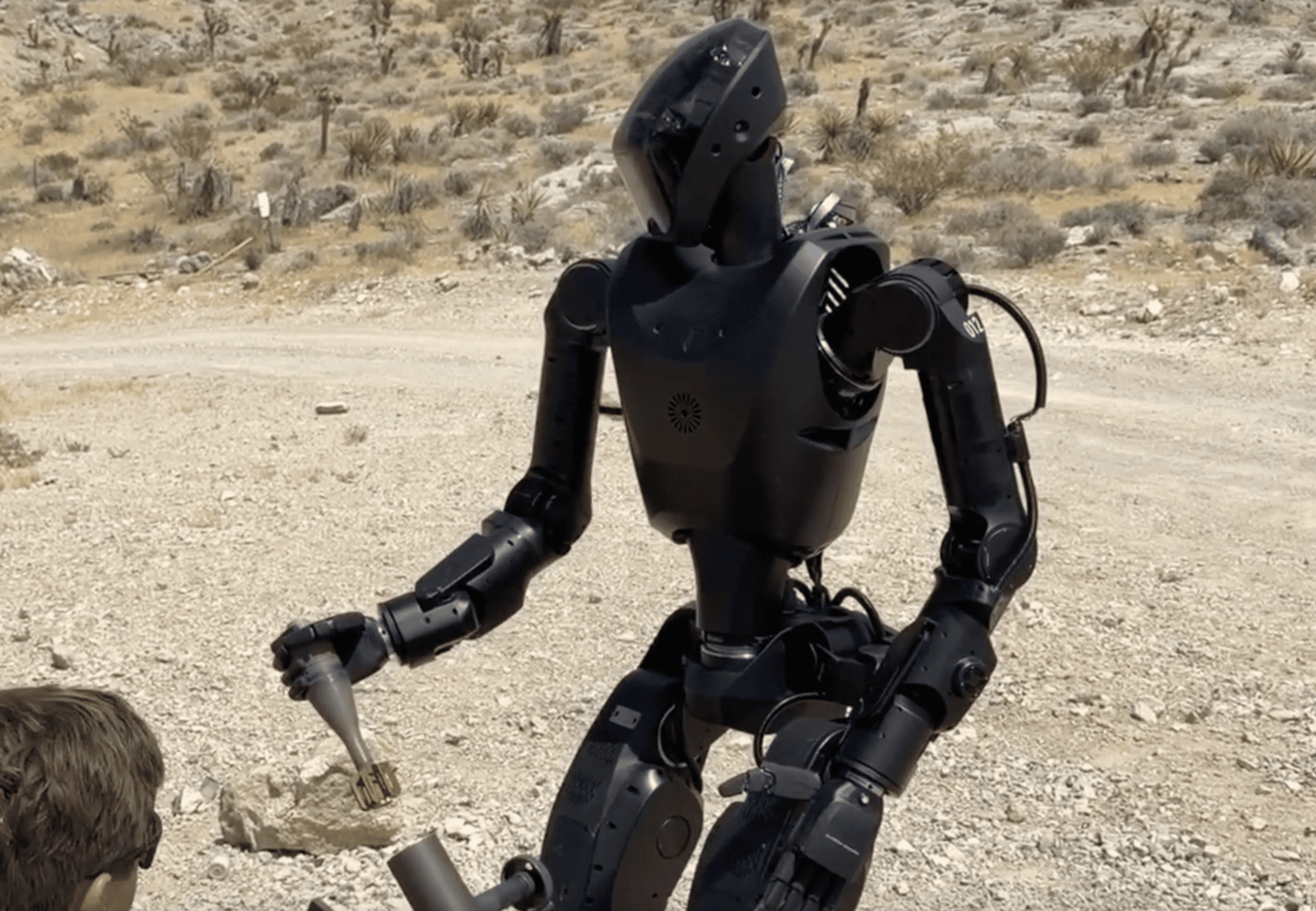
Its own site currently publishes demonstrations of Phantom carrying heavy payloads, walking autonomously, manipulating objects and performing a mortar-loading task.
Those are real robotics problems.
Balance is hard.
Hands are hard.
Battery life is hard.
Dust and water are hard.
Operating outside a controlled lab is hard.
Foundation says its next-generation Phantom MK2 is being designed to improve ruggedness, including water and dust resistance.
That is much less cinematic than a robot shrugging off an autocannon.
It is also much closer to where the engineering actually is.
The man behind Foundation has a story of his own
Sankaet Pathak did not come out of a traditional defense contractor.
He moved from Rajasthan, India, to Memphis to attend the University of Memphis. His early entrepreneurial work was fintech, not robotics.
Pathak co-founded Synapse, a banking-as-a-service company that became infrastructure behind numerous fintech products.
Then Synapse collapsed.
The company filed for Chapter 11 bankruptcy in April 2024, and the breakdown left tens of thousands of consumers and businesses unable to access accounts while Synapse, partner banks and fintech companies fought over records, balances and responsibility.
A few months later, Pathak was raising money for Foundation.
That does not tell us whether Phantom succeeds or fails.
It does make his background worth understanding instead of flattening him into “the robot CEO.”
Tap Sankaet Pathak above to pull his bio apart layer by layer: where he came from, the University of Memphis years, Synapse, the bankruptcy, and the jump into humanoid robotics.
The internet is beginning to manufacture tomorrow before tomorrow arrives
That may be the bigger Streets Wired story.
A few years ago, fake footage of a robot absorbing cannon fire would have looked ridiculous.
Now it lands in a feed next to real humanoids walking through factories, carrying military equipment and being pitched for battlefield work.
The gap between possible, prototype, company claim, real deployment and AI-generated spectacle is getting thin enough that a convincing clip can jump all five categories in somebody’s head before they finish reading the caption.
That is the trap.
The right question is no longer just:
“Is this video fake?”
It is also:
“How far away is the real thing?”
For the 20mm robot in the viral clip, the answer is simple: there is no verified test behind what is circulating.
For military humanoids more broadly, the answer is less comfortable.
They are already being built.
Receipts
- Archived repost preserving the “AI generated content” label
- LinkedIn repost noting the viral test is not independently verified
- Northrop Grumman: 20×102 mm ammunition specifications
- Foundation: official site and Phantom demonstrations
- Foundation: master plan and defense position
- WIRED: Foundation’s military-humanoid ambitions
- Andreessen Horowitz: Sankaet Pathak’s founding story
- University of Memphis: Pathak and early SynapsePay funding
- Associated Press: Synapse bankruptcy and frozen customer accounts
- TechCrunch: Pathak raises for Foundation after Synapse
01
The setup
The video looks like somebody skipped three generations of robotics overnight.
A black humanoid stands on a range. A burst hits its chest. Sparks explode. Smoke rolls off the body. The machine rocks, but it stays upright.
Then another robot appears and takes the same punishment.
Across Instagram, X, LinkedIn, Reddit and repost accounts, the caption has mutated into some version of the same claim:
a humanoid robot took a direct hit from a 20mm cannon and stayed standing.
That version is making the rounds right now.
It is also not what the evidence supports.
02
The clip traces back to AI-generated content
One widely circulated source carrying the same "20mm cannon hit" sequence explicitly labels it AI generated content.
Later reposts have been more slippery. Some call it a durability test. Some say it "reportedly" happened. Others hedge with phrases like "if authentic."
What none of them provide is the part that would turn an internet clip into an engineering test:
a manufacturer, a test organization, a location, a weapon system, an ammunition type, telemetry, a damage report, or an independent observer.
That absence matters.
A real test this extreme would not just be impressive footage. It would be a major materials, robotics and control-systems result.
03
Twenty millimeters is not a casual detail
"20mm" sounds like a measurement until you look at what that class of ammunition actually does.
Northrop Grumman's published data for common 20×102 mm ammunition lists projectiles around 98 to 99 grams traveling roughly 1,030 to 1,039 meters per second.
That puts a representative round at roughly 52,000 to 53,000 joules of muzzle energy before accounting for the specific projectile design and what happens at impact.
One of the listed rounds, PGU-28, is a semi-armor-piercing high-explosive incendiary cartridge intended for targets including light armor, aircraft, vehicles and materiel.
So if somebody genuinely built a bipedal machine that could repeatedly take that class of direct fire, remain balanced, protect its internal electronics and keep functioning, there would be a lot more to document than sparks.
04
The fake works because the real technology is catching up
This is where the story gets better.
The viral robot is synthetic.
The military-humanoid race is not.
Foundation Future Industries, a San Francisco robotics company founded in 2024, is openly building humanoids for industrial and defense work.
Its robot is called Phantom.
Foundation's own master plan says most American humanoid companies have committed to non-weaponization, while Foundation has deliberately chosen not to make that promise. The company says it wants its robots capable of operating in defense environments.
In July, WIRED reported that Foundation CEO Sankaet Pathak said the company was exploring "kinetic" capabilities for its humanoids.
Foundation also says Phantom MK1 has been tested with Ukrainian forces. WIRED noted that the company's government-contract story is more complicated than some public claims suggest: several contracts were inherited through its acquisition of Boardwalk Robotics or tied to the Institute for Human and Machine Cognition rather than won directly by Foundation.
That distinction matters.
So does another one:
working around soldiers is not the same thing as surviving cannon fire.
05
What real Phantom footage actually shows
Foundation does not need fake 20mm footage to be interesting.
Its own site currently publishes demonstrations of Phantom carrying heavy payloads, walking autonomously, manipulating objects and performing a mortar-loading task.
Those are real robotics problems.
Balance is hard.
Hands are hard.
Battery life is hard.
Dust and water are hard.
Operating outside a controlled lab is hard.
Foundation says its next-generation Phantom MK2 is being designed to improve ruggedness, including water and dust resistance.
That is much less cinematic than a robot shrugging off an autocannon.
It is also much closer to where the engineering actually is.
06
The man behind Foundation has a story of his own
Sankaet Pathak did not come out of a traditional defense contractor.
He moved from Rajasthan, India, to Memphis to attend the University of Memphis. His early entrepreneurial work was fintech, not robotics.
Pathak co-founded Synapse, a banking-as-a-service company that became infrastructure behind numerous fintech products.
Then Synapse collapsed.
The company filed for Chapter 11 bankruptcy in April 2024, and the breakdown left tens of thousands of consumers and businesses unable to access accounts while Synapse, partner banks and fintech companies fought over records, balances and responsibility.
A few months later, Pathak was raising money for Foundation.
That does not tell us whether Phantom succeeds or fails.
It does make his background worth understanding instead of flattening him into "the robot CEO."
Tap Sankaet Pathak above to pull his bio apart layer by layer: where he came from, the University of Memphis years, Synapse, the bankruptcy, and the jump into humanoid robotics.
07
The internet is beginning to manufacture tomorrow before tomorrow arrives
That may be the bigger Streets Wired story.
A few years ago, fake footage of a robot absorbing cannon fire would have looked ridiculous.
Now it lands in a feed next to real humanoids walking through factories, carrying military equipment and being pitched for battlefield work.
The gap between possible, prototype, company claim, real deployment and AI-generated spectacle is getting thin enough that a convincing clip can jump all five categories in somebody's head before they finish reading the caption.
That is the trap.
The right question is no longer just:
"Is this video fake?"
It is also:
"How far away is the real thing?"
For the 20mm robot in the viral clip, the answer is simple: there is no verified test behind what is circulating.
For military humanoids more broadly, the answer is less comfortable.
They are already being built.
### Receipts
Archived repost preserving the "AI generated content" label LinkedIn repost noting the viral test is not independently verified Northrop Grumman: 20×102 mm ammunition specifications Foundation: official site and Phantom demonstrations Foundation: master plan and defense position WIRED: Foundation's military-humanoid ambitions Andreessen Horowitz: Sankaet Pathak's founding story University of Memphis: Pathak and early SynapsePay funding Associated Press: Synapse bankruptcy and frozen customer accounts TechCrunch: Pathak raises for Foundation after Synapse
Streets Wired community
Join the conversation
What did this get right, miss, or make you think about?
Sign in to join the conversation.
Anyone can read comments. Posting, replying, and liking require a Streets Wired account.
Sign in / create profile →Member
Streets Wired member
Read freely. Sign in to post.
The conversation
0 responses
Loading the room…
Pull the Thread
What leaves a trail
Forensic reconstruction
Probe deeper
Price history
—Choose a range to inspect price history.
Probe this