Uncommon Knowledge
A Living Network on a Chip
Cortical Labs built the CL1 around cultured neurons and silicon electrodes. The strange part is not a brain inside a computer; it is a living network that can send signals back to software.
#Biological Computing #Neurons #CL1 #Cortical Labs #Future Tech
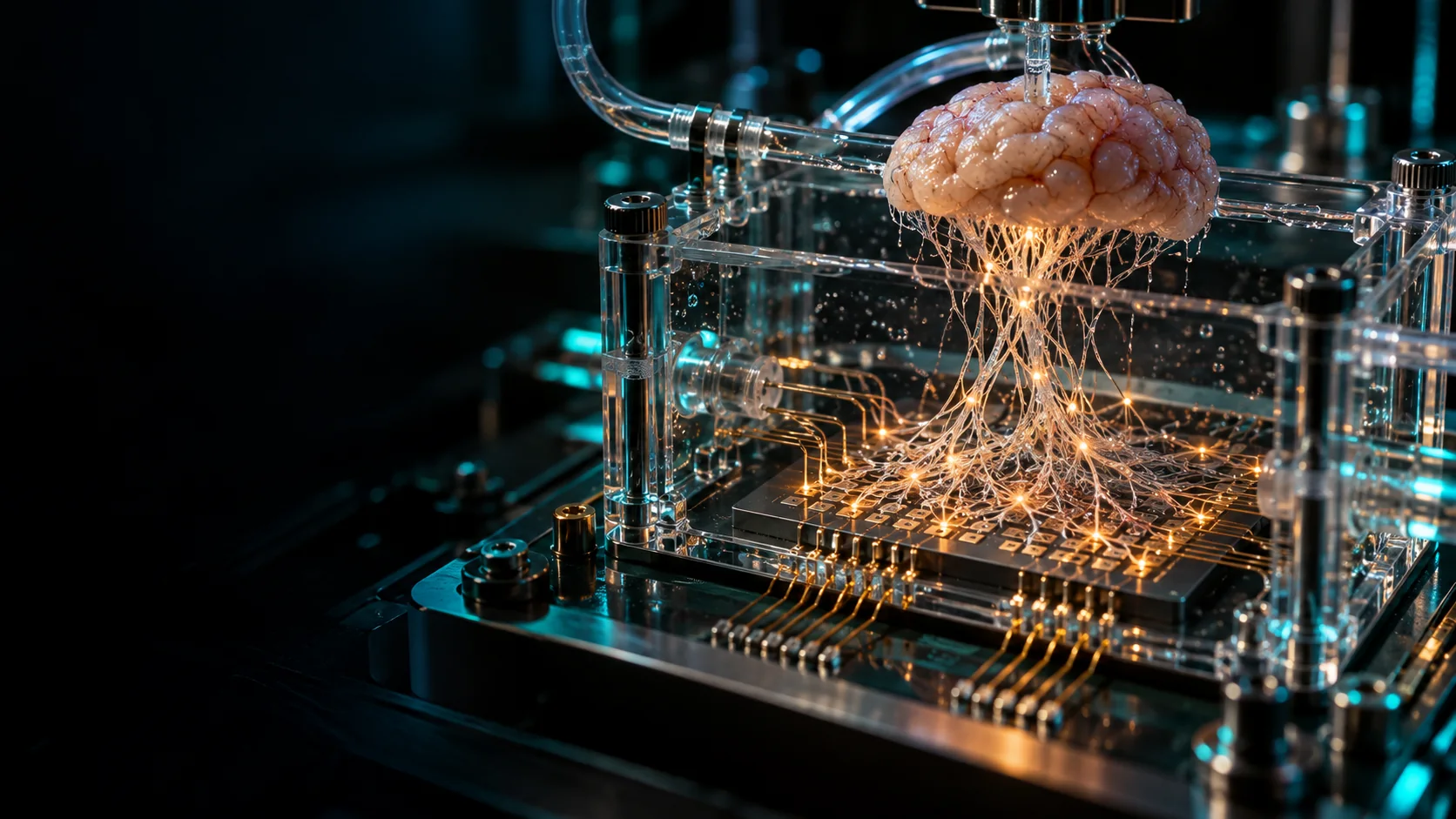
A chip can run code. Living neurons can change how they respond to signals. The CL1 puts those two facts in the same closed loop.
Melbourne-based Cortical Labs grows neurons across a silicon electrode array inside a controlled, nutrient-rich environment. The hardware delivers electrical stimulation to the culture and records its electrical activity. Cortical Labs’ software, biOS, can turn those signals into feedback in a simulated environment. The neurons respond; the software changes the next input. That loop is the experiment. The company says its self-contained CL1 includes the life-support hardware and can maintain cultures for up to six months.
What is doing the computing? The living network participates in processing inputs and producing responses. Conventional electronics still run the device, handle software, maintain the environment and translate signals. It is not a human brain removed and installed as a CPU. It is also not a drop-in replacement for a laptop processor.
The earlier DishBrain research published in Neuron connected cultured neurons to a simplified Pong-like simulation and measured changes in their activity during a closed-loop task. That experiment is a research result about adaptive behavior in a controlled setting, not proof that a culture thinks like a person. The paper’s use of the word “sentience” is contested territory; the safer claim is that the cells showed task-related adaptation under the experimental conditions.
The price tag
The CL1 was reported at about US$35,000 per unit at launch in 2025, including by IEEE Spectrum. Cortical Labs’ current purchase page does not display a public price. Treat $35,000 as a reported launch figure, not a verified quote for an order today. The company also offers remote access through Cortical Cloud.
Why this matters
Researchers could use a repeatable neuron-on-chip platform to study learning, disease models and responses to compounds while watching electrical activity in real time. Those are plausible research directions, not finished clinical tools or a proven substitute for general-purpose AI. Cortical Labs describes low-energy operation, but a fair comparison must count the entire system: pumps, environmental control, electronics and maintenance, not just the neurons.
The uncommon knowledge is the interface: software can ask a living cell network a question with patterned electrical input, then read the answer in its spikes. The story gets deeper from there: whose cells are used, what consent covers, how repeatable cultures are, and when a complex neural network might warrant a different ethical conversation.
Visual note: the hero artwork is a conceptual illustration. The CL1 uses cultured neurons on electrodes, not a miniature anatomical brain suspended above a chip.